Fiction has always been my thing. I find it wild — one person sits down and imagines everything, entire worlds, the people, the characters, out of nothing. Gives them light, dark, grey. Makes them real enough that you forget it’s made up. If you are too much into it, you kind of miss them when the book ends.
I have immense respect for all writers. The best part — I sincerely believe that the ideas and the writing till now have been AI free. The conspiracies they conjure are original, and even if the source of the idea is some real-life incident, the author has made the effort to make it readable. I am not too sure about the coming years though.
I’ve come a long way from where I started reading, and for the appraisal which nobody cares about other than me — the progress in my reading journey has been satisfying.
I started with Hindi magazines — Nandan, Champak, Nanhe Samrat. My convent school library then introduced me to Children’s Digest and Tinkle. Slowly, I read whatever I could get my hands on, whatever was lying around the house or at a relative’s place. Sneaking books out from my father’s collection and reading Surender Mohan Pathak’s Hindi thriller novels was a favourite pastime.
When I ran out of new stuff and the old magazines/books were already read three times over, I quietly picked up Grihshobha and Sarita. Don’t judge. I was just a curious kid, hungry to read anything with a story in it. And these magazines had some really wild stories back in those times. Those next-door-family stories hit different at that age, back in the late 1990s — small dramas that felt massive.
Then Enid Blyton, Famous Five, Hardy Boys happened. College started with Chetan Bhagat and Durjoy Dutta, and on my innumerable trips between Dehradun and Meerut while in college, I chose the cheaper option of Hindi novel writers Ved Prakash Sharma and Keshav Pandit.
A long time back, I stopped caring what people thought about what I was reading, for two reasons. A. It’s a personal taste, like music. Nobody gets to judge that. You should not ask someone why they like the songs they like. Same rule should apply to books, but it never does — until you stop giving people the option to ask. B. You evolve. You slowly find out exactly what it is you like. For that to happen, you need to give yourself options — read a lot of books and then find your thing.
In 2011, I read John Grisham’s The Rainmaker, and that was the jump. Just like most of the books, it was completely coincidental. But legal thrillers became my thing. I’d finish his books the second I got them — sometimes in a single sitting, ignoring everything else I was supposed to be doing.
Grisham knew how to plot. Man could build a courtroom scene like nobody else. But his characters? Flat. You’d finish the book and remember the twist. The characters- never. Not the person it happened to. No emotional depth to them.
I realised the lack of emotional angle in Grisham’s books only when, again by pure luck, I found Michael Connelly — in a nondescript corner bookstore in Andheri market. Connelly is the creator of Harry Bosch. And Bosch slowly became my favourite character — not just favourite in a genre, favourite, period. The lines below is from one of the first Connelly books I read. I did not know anything but to get hooked to the guy.
“There is no end of things in the heart.
Somebody once told me that. She said it came from a poem she believed in. She understood it to mean that if you took something to heart, really brought it inside those red velvet folds, then it would always be there for you. No matter what happened, it would be there waiting. She said this could mean a person, a place, a dream. A mission. Anything sacred. She told me that it is all connected in those secret folds. Always. It is all part of the same and will always be there, carrying the same beat as your heart.
I am fifty-two-years old and I believe it. At night when I try to sleep but can’t, that is when I know it. It is when all the pathways seem to connect and I see the people I have loved and hated and helped and hurt. I see the hands that reach for me. I hear the beat and see and understand what I must do. I know my mission and I know there is no turning away or turning back. And it is in those moments that I know there is no end of things in the heart.”
― Michael Connelly, Lost Light
Connelly’s legal writing is brilliant, but he did something Grisham never did — he built the character, not just the plot. You could feel it on every page. I think it’s because Bosch was Connelly’s favourite too — most of his books are about the same guy, and you can tell he never got tired of him. I connected with that kind of loyalty to a character. With Bosch being my guide, I felt like I knew Los Angeles like my own street. Bosch stayed with me long after I closed the book, the way a real person would.
But when you’re on a reading streak, you want more. And that’s the problem — every writer only has so many books in them, and eventually you catch up to all of it. So, you take a chance. In the hunt for a good book and a new author, you read some bad ones, real bad ones. In that hunt, and soon enough, I stumbled onto Scott Turow’s Innocent.
500 pages. Slow to start, too much elaboration of the characters and the settings. Became frustrating sometimes. Sometimes the prose reads too high calibre. And then, all of a sudden, it grabs you by the collar and doesn’t let go till the last page.
And I realised — the last page just solved the mystery. You don’t remember that. You read, admire, silently clap, and move on. The books are about how it is told, the patience of it, and the trust in the writer’s effort that the reader would stay till last. More importantly, how he reached the last page.
Innocent did have a crime to solve, with some brilliant legal scenes and courtroom drama. I read it, read it again, and started searching for more of Mr. Turow. Unfortunately, for me, he is not a very prolific writer.
Limited output, barely a handful of books (13 fiction books of which I have read 3), but every one filled me up completely. He gave me the legal thriller I wanted, but also the built-up — the character’s head, his monologues, how he actually thinks through a problem instead of just acting on it. That’s what I didn’t know I was craving until I got it.
Writing used to be my Friday night thing. I genuinely believed — give me any idea and I’ll turn it into 500 words, no problem, no thinking required. I did that for a while, even sold a few blogs, decent money at the time, enough to feel like I was onto something. Looking back, it was naive writing. There was a plot when I wrote stories, sure, a beginning and an end. But I couldn’t get the emotion out the way I wanted to. It read fine. It just didn’t feel like anything.
Jo dhoondte hai, wo mil hi jaata hai.
(You eventually get what you are looking for.)
Somewhere in my head I wanted to be a writer who could dig into people’s emotional side, really get under the skin of a character. But here’s the catch — I don’t have a devilish streak in me, and you need one to write well, or at least to write a villain well. You have to know how the bad guy thinks, not just the hero — you have to sit in his head long enough to make him make sense. You need manipulations. Every story needs a proper bad guy, or the good guy means nothing, has nothing to push against.
Even Rajshri Films knew this — every “happy family” needed a vamp to make it work, someone to root against so the rest could shine. In Hum Aapke Hain Koun, when they couldn’t find anyone to play that role, they just killed off the Bhabhi everyone loved instead. That’s how far they’d go for a good tragedy. Because people love a good tragedy, always have, always will.
Sorry, got sidetracked. Point is, chasing a story that felt real and hit hard emotionally (never read Harry Potter, by the way, still haven’t), I went from Grisham to Connelly to Turow. Each one taught me something the last one didn’t. And Turow — even now — nobody’s beaten him for me. Doubt anyone will.
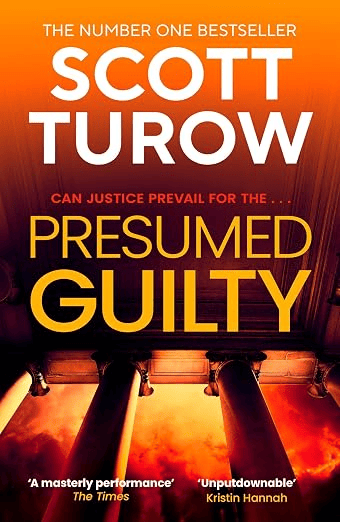
I finished Presumed Guilty a while back. It’s still with me, more than I expected. Rusty Sabich is 77 in this one. A man who spent his whole career putting people on trial and delivering verdicts, now standing on the other side, defending his fiancée’s son. You can sense the weight of that on every page. It’s not only about solving a crime. It’s about trying to understand people. Love here is tangled, never straightforward, like it often is. By the end, I felt like I had stepped inside the mind of a 77-year-old man, watching him question everything he had built his life on.
That’s the kind of writing I keep going back to books for. I’ll probably never be able to write it myself. But I know what I’ve been searching for every time I open a book. And Turow, once again, gave me exactly that.


Leave a comment